Product images
Category Accessories
Related products
Simplify your soil probe installation
The quality of the data measured by a moisture probe depends directly on the quality of its installation. Air pockets or holes that are too wide will distort the results.
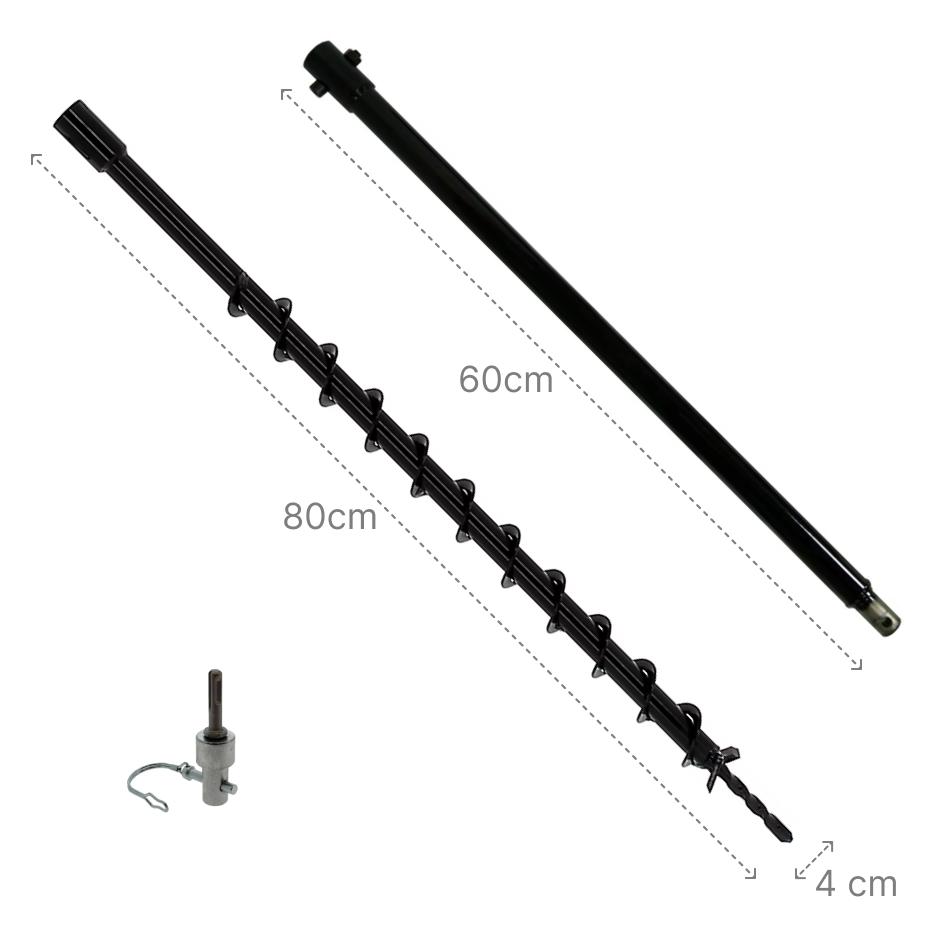
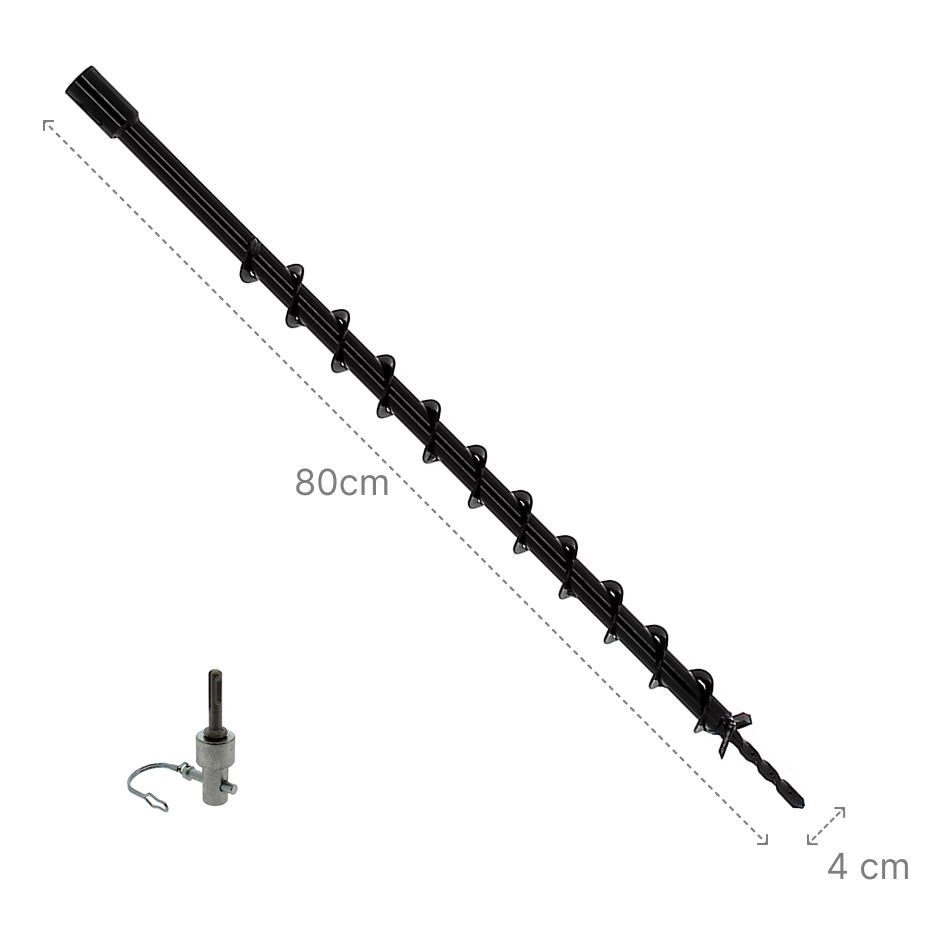
This Ø40 mm auger bit has been selected to provide clean and consistent drilling, making it easier to insert the probe while ensuring ideal soil compression against the probe tube.
The coupling is designed to fit most power augers on the market. Its steel structure allows for efficient soil extraction, even in clay-heavy or compact soils.
Which length should you choose?
| Length | SKU | Composition | Price (excl. VAT) | Recommended Use |
|---|---|---|---|---|
| 80 cm | DRILL-40-800 | One-piece bit | 45 € | AKS-30, AKS-60 probes |
| 140 cm | DRILL-40-1400 | Bit + Extension | 70 € | AKS-90, AKS-120 probes |
Technical Specifications
- Material: High-resistance steel
- Diameter: 40 mm
- Compatibility: Power augers and handheld drills (adapter sleeve included)
Installation Tip: For perfect results, pull the bit out regularly during drilling to clear the soil and avoid compaction at the bottom of the hole.
Frequently asked questions
Why use a precisely 40 mm drill bit?
The 40 mm diameter is perfectly sized for AKS probes. Precise drilling ensures tight contact between the probe wall and the soil, which is essential for the accuracy of capacitive moisture measurements.
Can I use this bit with a standard handheld drill?
Yes, the bit is compatible with most standard gas-powered augers, but can also be used with a powerful handheld drill/driver thanks to the included adapter, suitable for light soils or 80 cm depths.
What is the difference between the 80 cm and 140 cm versions?
The 80 cm version is a one-piece bit ideal for AKS-30 and AKS-60 probes. The 140 cm version includes the base bit and a 60 cm extension rod to allow for the installation of longer probes (AKS-90 and AKS-120) or to drill deeper if necessary.
Is the bit resistant to stony soils?
The bit is made of high-resistance steel designed for durability. However, in the presence of large stones or bedrock, it is advisable to drill in stages to avoid prematurely dulling the cutting edge or jamming the tool.